

 English
 русский
 Français
 Español
 عربى



Can Sunglasses Lens Size Affect Edge Distortion
Nov 13,2026
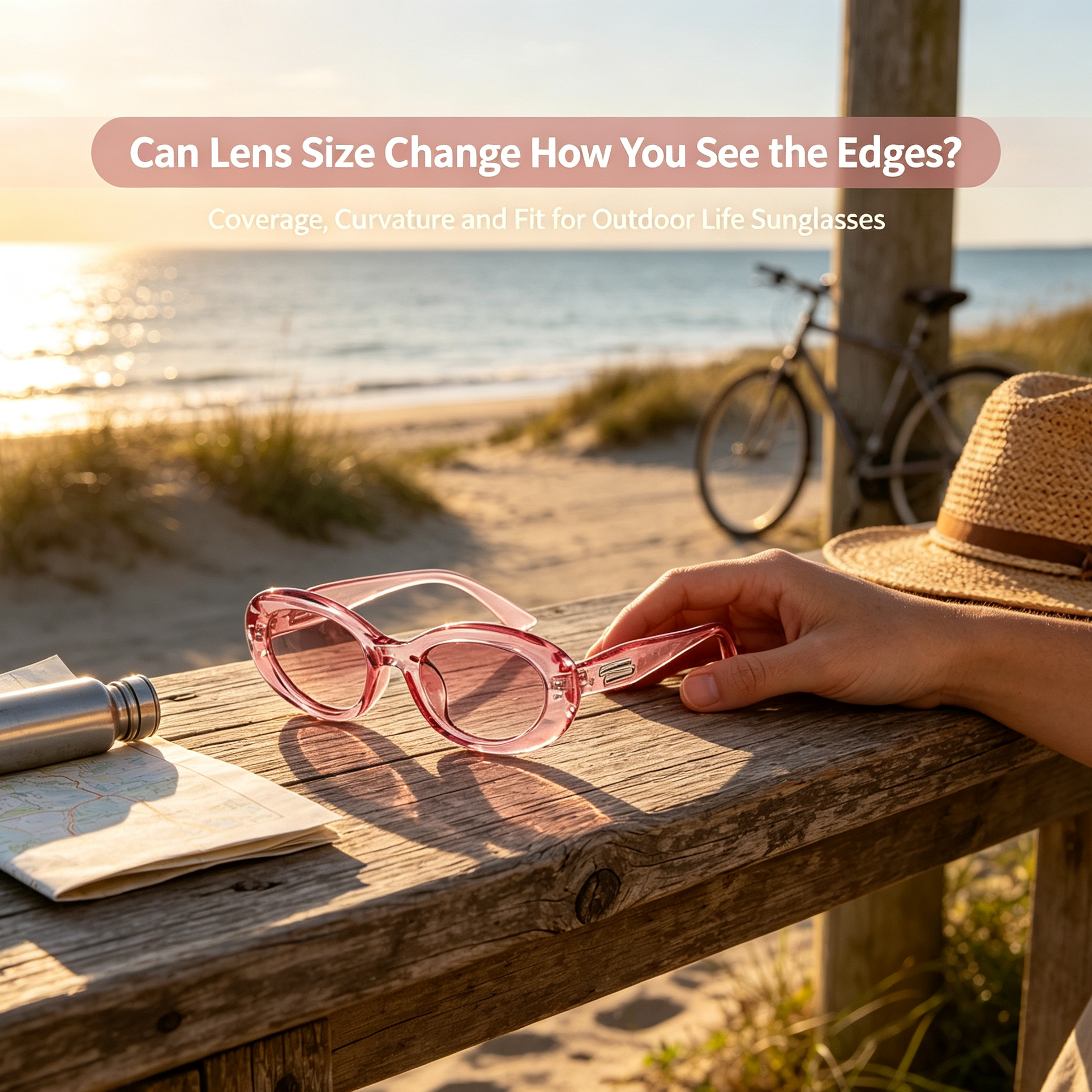
Time outdoors means changing light, moving scenery, reflective surfaces, and different viewing angles. Whether the setting is a coastal path, an open road on a bicycle, or a weekend by the water, eyewear shapes how comfortably people take in their surroundings. When choosing Sunglasses Lens Size, many shoppers think about appearance and coverage, yet another question deserves attention: can the size and shape of a lens change how things look near its edges? The answer involves more than dimensions. Lens curvature, optical quality, material, frame position, and facial fit all affect how objects appear through the glass. Understanding these factors supports sensible choices among Outdoor Life Sunglasses for everyday use.
Coverage Is Not the Same as Clear Vision
Lens size decides how much of the area around the eyes the sunglasses cover. A wide or tall lens shields more of the surrounding space, while a compact one leaves more of the face open. Physical coverage and usable peripheral vision are different things, though. A large lens does not automatically give a wider or clearer field of view, because its shape, position, and optical character also decide what the wearer sees.
Oversized lenses have become familiar among people who enjoy outdoor activity and bold everyday styles. The larger surface covers more of the eye area, which helps where sunlight arrives from several directions. Advantages include greater coverage, less light entering at certain side angles, some shelter from wind and airborne particles, and more room for different frame designs. For hiking, fishing, and walking in open country, that extra coverage can feel more comfortable. The wearer should still check that the lens edges give a clear view instead of assuming that bigger means better.
Smaller lenses give a more compact appearance and, depending on the frame, leave more of the facial area uncovered. They are not automatically clearer or less clear, since optical performance rests on the same factors that govern larger lenses.
| Feature | Larger Lenses | Smaller Lenses |
|---|---|---|
| Physical coverage | Broader area | More limited area |
| Styling | Bold and expressive | Compact and understated |
| Outdoor use | Useful when extra coverage is wanted | Suited to casual outdoor wear |
| Peripheral viewing | Depends on shape and fit | Depends on shape and fit |
| Comfort | Depends on weight and frame position | Depends on proportions and fit |
How the sunglasses sit on the face and how clearly the wearer sees across the whole lens matter more than the label on the size.
What Causes Distortion Near the Edges
Distortion happens when light passing through a lens does not keep the expected appearance or position of objects. Straight lines may look slightly curved, objects may seem shifted, and the scene may feel different when the eyes turn toward the lens edge. Size alone does not decide these effects. Several design and manufacturing factors do.
Curvature is one of them. Curved lenses are common in sports and outdoor sunglasses because the frame can follow the contours of the face and give extra side coverage. Stronger curvature brings optical design questions, however. If a curved lens is not made to manage light properly, the wearer may notice straight objects looking bent, a change in the apparent position of nearby things, uncomfortable transitions when moving the eyes, or a difference in clarity between the centre and the edges. This matters particularly for wraparound styles, so a curved design should be judged as a complete optical system and not by its appearance.
Material and manufacturing quality also count. Material affects weight, durability, optical properties, and handling, and a lens that looks dark or feels light is not necessarily well made. Uneven surfaces, inconsistent thickness, scratches, or small flaws can interfere with a clear view. Look for consistent clarity across the whole lens, smooth surfaces without visible defects, a material suited to the intended activity, and protection information from the maker. An attractive lens is not necessarily a good optical lens.
Frame position matters as well. Even a carefully designed lens feels uncomfortable in a poorly fitted frame. The distance between eyes and lenses, the angle of the frame, and the position of the nose bridge all influence how the glasses sit. An unsuitable fit can place the eyes in parts of the lens that were never meant for comfortable viewing, so frame choice should reflect facial proportions as well as lens dimensions.
Do Large Lenses Cause More Edge Distortion?
Not necessarily. The distinction lies between a lens's physical size and its optical design. A large lens with carefully controlled curvature can be comfortable to look through, while a small lens with unsuitable optical characteristics can still cause discomfort.
Picture two pairs with similarly wide lenses. One has a gentle curve and the other a pronounced wraparound shape. They may look alike in a photograph, yet their optical behaviour can differ. Lens width alone is a poor guide to visual quality.
Large lenses can create extra difficulties when the design does not suit the wearer's face. An oversized frame might sit too close to the cheeks or extend beyond the natural position of the eyes, which affects the viewing area used in everyday movement, the position of the lens relative to the eyes, the amount of side coverage, and overall stability. A pair that feels fine while standing still may feel different while walking, bending, or turning the head, so it helps to try sunglasses during natural head and eye movements.
Large or Small for Outdoor Activities
Outdoor settings place different demands on eyewear. A walker in shaded woodland has different needs from a cyclist on an open road or someone beside reflective water. Rather than choosing by size, think about the activity, surrounding light, desired coverage, and comfort.
Larger lenses suit situations where extra coverage matters, such as hiking, camping, and fishing, where sunlight, wind, and reflected light all reach the eyes. They give added coverage at the sides and a broad surface that works with many frame styles. Check UV protection through the product specifications, since darkness and physical size do not establish the level of UV protection.
Smaller lenses appeal to people who prefer lightweight-looking frames and a restrained appearance. They work for casual walks, outdoor meals, and everyday activity. A smaller design still needs suitable protection and comfortable use.
| Activity | Lens Considerations | Frame Considerations |
|---|---|---|
| Hiking | Clear vision across changing scenery | Secure, comfortable fit |
| Cycling | Side coverage, stable position | Compatibility with a helmet |
| Fishing | Glare management, clarity | Comfort over long periods |
| Camping | Suitable UV protection, versatile coverage | Lightweight everyday comfort |
| Walking | Balanced coverage, natural vision | Easy fit for daily wear |
| Beach activities | Protection from direct and reflected light | Stable position on the face |
Testing Sunglasses Before You Buy
Lens size makes more sense alongside optical quality and frame fit, and photographs reveal little about either. A short routine in the shop or at home gives better information.
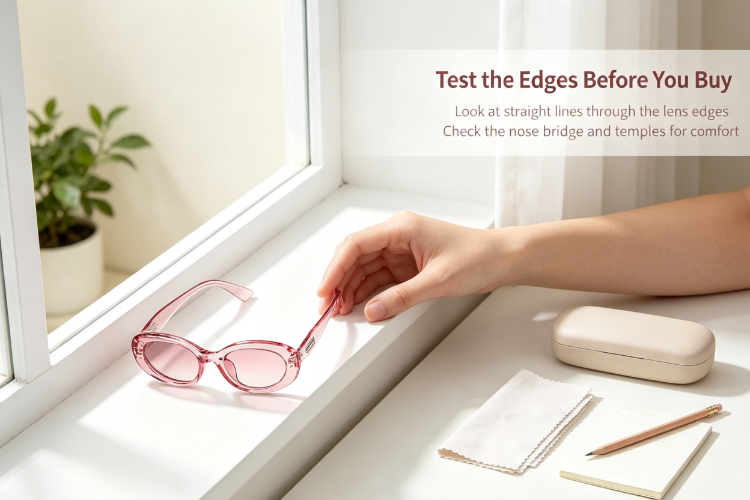
Look at the lens shape from the front and the side. A strongly curved lens may add coverage, but its optical design should suit the frame. Put the sunglasses on and look straight ahead through the centre of each lens. Move your eyes toward the left and right edges and see whether straight objects, such as a door frame or a window, look noticeably bent. Turn your head naturally and check that the scene stays comfortable. If distortion persists, try another frame or lens design instead of assuming you will get used to it.
Do not let colour, mirror finish, or frame proportions stand in for quality. Look for information about lens material, surface quality, UV protection, polarisation where it suits the activity, clarity across the viewing area, and compatibility with a prescription. Prescription sunglasses need professional fitting, because prescription strength influences optical performance.
Fit deserves equal attention. The nose bridge should rest comfortably without slipping or pinching. The arms should hold the frame securely without squeezing the temples. The lower lens edge should clear the cheeks during facial movement, the eyes should sit properly behind the lenses, and the side coverage should suit the environment. A frame that fits well keeps a consistent viewing position when you move.
Light changes through the day and across settings, so consider tint, UV protection, and glare management alongside size. Polarised lenses reduce reflected glare from water and roads, though suitability depends on the activity and personal needs.
Thinking About Outdoor Life Sunglasses
Sunglasses for outdoor use involve more than a fashionable frame. The design should support the way people move and explore. Outdoor Life Sunglasses can be assessed through a combination of practical points: lens dimensions, optical clarity, coverage, frame stability, and everyday comfort.
When comparing styles, ask a few questions. Does the lens shape give the coverage you need? Is the frame comfortable around the nose and temples? Is there clear information about UV protection? Does the lens design suit your preferred activities? Can you see comfortably through the edges as well as the centre?
Sunglasses Lens Size gives an impression of coverage, while optical design and frame fit decide how comfortable the view is from edge to edge.
 PREV:
Your email address will not be published. Required fields are marked *
CATEGORY
NEW PRODUCTS
-
Nov 13,2026
-
-

You can contact us at any time, and we will reply to you within 24 hours.
- 3-11, Optical Mall, No. 777, Huancheng North Road, Duqiao Town, Linhai, Taizhou City, Zhejiang, China.
- +86-576-85885058
- +86-18258841999
- yani@yaniglasses.com
Custom Fashionable Sunglass Manufacturers
