

 English
 русский
 Français
 Español
 عربى



What Do Blue Ray Blocking Glasses Ratings Really Mean
Oct 30,2026
A product page highlights one percentage and suggests that a larger figure means stronger protection. The number is easy to compare, but it leaves out a good deal. Which wavelengths were measured, how much visible light still passes through, and whether a test report backs up the claim all shape the real experience.
Blue Ray Blocking Glasses reduce selected blue light reaching the eyes, and two lenses with similar wording can behave differently. Shoppers, retailers, and wholesale buyers get a clearer picture by reading the blocking rate, the light transmission, and the test report as three separate pieces of information.
What a Blocking Rate Tells You
A blocking rate describes how much light within a defined range a lens prevents from passing through. The figure depends on the wavelength range tested and the calculation method. A single overall percentage may refer to a narrow band or a wider section of visible light, and the product page does not always say which.
A larger figure does not suit every user. Someone editing photos may prefer a lens that keeps colors natural, while an office worker may care more about comfort under bright ceiling lights.
| Information | What It Can Tell You | What Still Needs Checking |
|---|---|---|
| Blocking rate | Stated amount filtered within a test range | Which wavelengths were tested |
| Filtering range | Part of the spectrum the lens affects | Whether it matches the intended use |
| Light transmission | How much visible light passes through | Whether the view suits the wearer |
| Test report | Conditions and results of a test | Whether it matches the product sold |
The blocking rate is one line in a product description. It does not measure overall lens quality or personal suitability.
Wavelength Range, Transmission, and Lens Color
Why the Range Matters
Blue light spans a range of visible wavelengths. A lens may filter some portions and let others through, so two lenses with matching percentages can have different filtering profiles. Blue light is also part of ordinary daylight and appears in screens and indoor lighting. Removing all of it is not the goal of a filtering lens, and stronger filtering is not needed for every activity.
Look for a description of the tested range and how the reported rate relates to it. A page that explains its scope is easier to compare than one that offers only a percentage.
Light Transmission
Light transmission refers to the amount of light that passes through a lens. Its meaning can differ from the blocking rate in terms of wavelength range and calculation method. One lens may filter selected blue wavelengths while allowing other light to pass through. Another may reduce brightness across the entire field of view.
A darker lens can feel inconvenient in a dim office or during evening activities. A lens that transmits more visible light may feel more natural, though glare, room lighting, fit, and personal sensitivity also play a part.
What the Tint Suggests
Some lenses carry a yellow or amber tint, and others look nearly clear. Color offers a visual clue, but it cannot replace measurements. A tint does not reveal which wavelengths are filtered, and a clear-looking lens should not be assumed to have no filtering effect. People who handle color-sensitive work, such as design layouts or clothing samples, notice tint differences quickly.
| Lens Characteristic | Possible Effect on Use |
|---|---|
| Narrow filtering range | Affects a limited part of the spectrum |
| Broader filtering range | Affects a wider portion of visible light |
| Uneven filtering profile | May change color appearance unevenly |
| Balanced transmission | May keep the view more natural |
These rows describe general design differences and are not a ranking. Results depend on the lens material, coating, tint, and filtering profile.
Protection Claims and Product Names
The phrase "eye protection" covers several concerns: glare, visual discomfort, wavelength filtering, and screen-use routines. Each relates to different features. A lens that filters selected blue light does not necessarily prevent every form of discomfort. Screen-related symptoms can also come from long near work, reduced blinking, dry eyes, reflections, poor lighting, or an awkward viewing position.
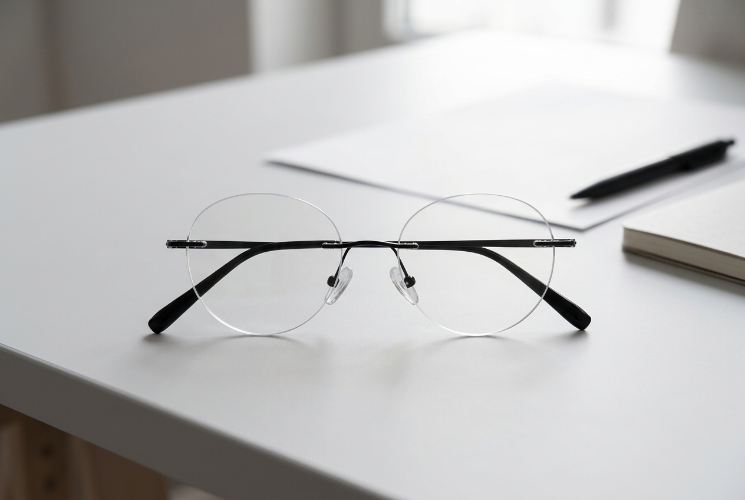
Computer Eye Protection Glasses is a broad label. It may describe glasses with prescription correction for screen distance, anti-reflective coating, blue-light filtering, or a mix. Blue Ray Blocking Glasses usually points to filtering selected blue wavelengths. Neither name guarantees a specific optical performance, so the specifications matter more than the category.
Evidence that a lens filters certain wavelengths does not prove it will relieve strain or improve sleep for every wearer. Breaks, comfortable viewing distance, suitable brightness, and attention to dry-eye symptoms remain relevant while wearing any pair.
Reading Test Reports and Asking Suppliers
Checking a Report
A test report helps confirm that claims rest on measurements. It should be relevant to the product in hand, since a report for a different material, coating, or model may not describe the item being purchased.
- Product identification: Does it name the same product or lens type?
- Test scope: Which optical properties and wavelength ranges were assessed?
- Method: How were the measurements obtained?
- Results: Are measured values and units shown, beyond a marketing summary?
- Testing organization: Who ran the test?
- Consistency: Do the report and the product page agree?
When a report shows only one percentage without a range or calculation method, the figure offers limited grounds for comparison. That does not make the product unsuitable. It means the number should not be assumed to describe all blue light or the overall view through the lens.
| Report Detail | Question to Ask |
|---|---|
| Blocking percentage | What range does it cover? |
| Wavelength information | Which parts of the spectrum were measured? |
| Transmission results | How much visible light passes through? |
| Product reference | Does it match the item being sold? |
| Test conditions | Under what conditions were results obtained? |
Questions for Suppliers
Retailers and wholesale buyers reuse product information in listings, packaging, and customer replies, so gaps carry forward. Ask which wavelengths the lens filters, how the rate is defined, whether transmission is described separately, and whether the report identifies the supplied product. Ask also how the supplier explains any tint or color change. A supplier who answers clearly makes comparison easier.
Matching Glasses to Daily Use
Intended use narrows the options. A bright office, a dim room in the evening, and a color-sensitive job each call for different priorities.
| Intended Use | Details Worth Reviewing |
|---|---|
| General computer work | Transmission, color appearance, glare, fit |
| Color-sensitive tasks | Color changes and transmission profile |
| Evening screen use | Filtering information, room lighting, comfort |
| Retail or wholesale supply | Test documentation and accurate claims |
Frame fit counts as much as the lens. A well-documented lens is still a nuisance if the frame slips, presses on the face, or conflicts with other eyewear.
Claims should match what a product can demonstrate. Filtering selected wavelengths differs from preventing eye disease, ending eye strain, or guaranteeing sleep. Reports should only support the product they describe, and descriptions should admit uncertainty where evidence is limited.
A higher number is not an automatic advantage. Checking what it measures, whether a report supports it, and how the lens fits the wearer's routine gives a firmer basis for choosing.
 PREV:
Your email address will not be published. Required fields are marked *
CATEGORY
NEW PRODUCTS



You can contact us at any time, and we will reply to you within 24 hours.
- 3-11, Optical Mall, No. 777, Huancheng North Road, Duqiao Town, Linhai, Taizhou City, Zhejiang, China.
- +86-576-85885058
- +86-18258841999
- yani@yaniglasses.com
Custom Fashionable Sunglass Manufacturers
